Research / Inquiry

Questions worth following.

My research practice moves from field observation to datasets, models, evaluation and the human consequences of technical systems.

06

01 / Interests

The territories I keep returning to.

01

Deep Learning

The backbone of nearly everything I build. I care less about state-of-the-art scores and more about whether it works reliably outside the lab.

02

Computer Vision

What machines learn to see — from real-time road hazard detection to adversarial threats in medical scans. Most of my applied work lives here.

03

Interpretable AI (XAI)

A model that cannot explain itself is difficult to trust. I work toward systems that surface their reasoning — especially when the decisions are consequential.

04

Multimodal AI

Where language meets vision and audio — grounding models in real-world context and advancing cross-modal reasoning and alignment.

05

Responsible AI

Technology that affects people should be accountable to them. I think about privacy, fairness, and who tends to get left out of the design process.

06

Machine Learning

Building learning systems that generalize well. I focus on robustness, evaluation rigor, and understanding what a model is actually doing.

07

Multimodal LLMs

The convergence of language and vision is where I see the most open questions right now — around grounding, safety, and genuine real-world utility.

08

Human-Computer Interaction

I run field studies alongside building systems. Sitting with people in their actual context consistently changes what I think the system should do.

02 / Publications

Published and in progress.

Journals
01 · 2024 · IEEE Access (Q1)
Journal

SafeTrax: Smart Collision Prediction and Alert System Using IoT for Sustainable Traffic Safety
Md Fahim Bin Amin, Israt Jahan Khan, Faria Akter, Adib Ahmed, Md Motaharul Islam

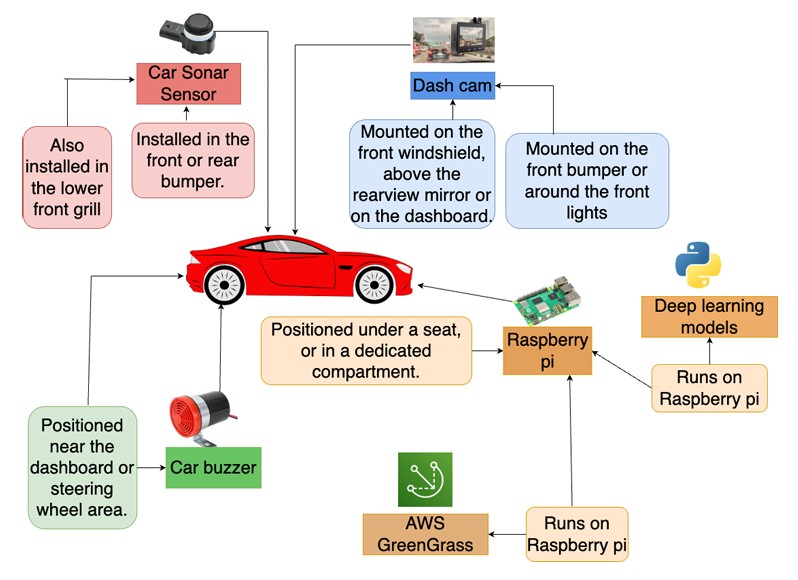
SafeTrax system architecture: IoT sensors, Raspberry Pi, AWS Greengrass, deep learning pipeline

Fig. 1 — SafeTrax end-to-end system architecture

Abstract

SafeTrax uses deep learning to predict traffic accidents and car crashes. It has been implemented with the Internet of Things (IoT) to gather real-time data from sensors, and AWS Greengrass to process that data quickly and give drivers timely warnings. Unlike old safety systems, SafeTrax can predict if an accident might happen. It warns drivers beforehand to make roads safer for cars, people, and other animals. One important part of SafeTrax is the integration of AWS IoT Greengrass, which helps the system work faster by using cloud services on devices like the Raspberry Pi.

Contributions

01

Predictive collision detection pipeline using deep learning trained on real-time IoT sensor streams.

02

AWS IoT Greengrass integration enabling edge inference on Raspberry Pi with sub-second alert latency.

03

End-to-end system from sensor data ingestion to proactive driver warnings before accidents occur.

Headline Results

Edge Device

Raspberry Pi

Cloud Integration

AWS Greengrass

Approach

Deep Learning + IoT
Conferences
01 · 2025 · ICCIT 2025
Conference

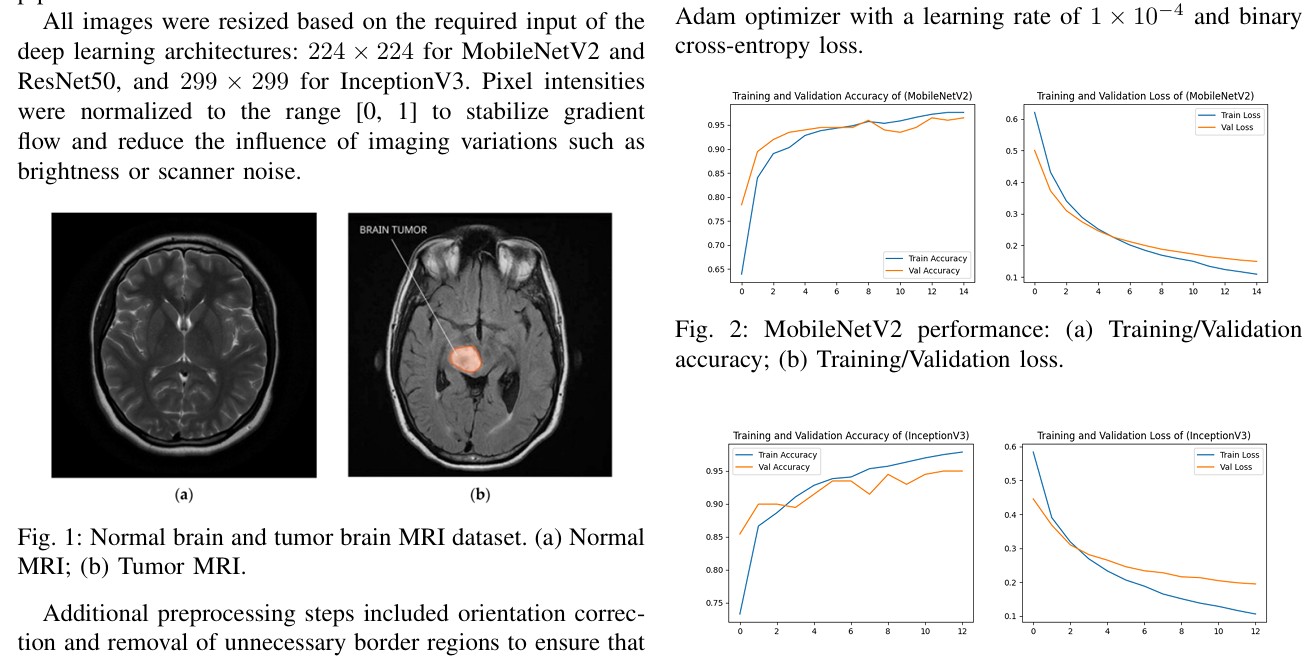
Mitigating Adversarial Vulnerabilities in Brain Tumor Imaging: Threat Analysis and Defense Strategies

Md. Awinul Hoque Utsha; Ezaz Mahmud Jim; Mynuddin Patwary; Faria Akter; Rizwan Ahmed; Farshid Rafiq

Adversarial attack and defense framework for MRI-based brain tumor classification using ensemble deep learning

Fig. 1 — Ensemble framework with adversarial threat analysis for brain tumor MRI classification

Abstract

Medical image analysis using deep learning has made tremendous progress, but the robustness of such systems in realclinical settings is still hampered by model instability and adversarial sensitivity. This paper presents an efficient ensemble-motivated framework for MRI-based brain tumor prediction, incorporating three state-of-the-art networks (including InceptionV3, MobileNetV2 and ResNet50) to enhance diagnosis correctness and prognosis stability. In order to compensate the lack of dataset, we used heavy augmentations such as adding Gaussian noiseand rotation to between fivefold of the amount in training data and obtained the improved generalization. Every model was fine-tuned onaugmented dataset, and their probabilistic predictions were aggregated via soft-voting ensemble learning to achieve more consistent and accurate results than any single model. Apart from general classification, we focus on adversarialthreats to medical imaging systems in this work. We used four popular adversarial attack algorithms—FGSM, BIM, PGD and CW to analyze how easily our model could be fooled by the imperceptible perturbations that are able to corruptclinical judgment. To defend against these threats, adversarial training and ensemble architectural diversity were employed as defenses. Experimental results show adding the proposed technique increases this accuracy to 92% and our particularly higher recall in tumours lead to a lower risk of false-negativediagnoses. In addition, the ensemble is more robustunder adversarial perturbations than each individual model. In general, this workemphasizes the importance of combining high-performance classification and adversarial robustness for safe, reliable, as well as trustworthy AI-based brain tumor detection in clinical care.

Adversarial MLMedical ImagingDeep LearningComputer Vision
In progress 2026

NBIAD-8

Hybrid deep learning and interpretable insights for pedestrian road safety.

In progress 2026

ROWA-6

Roadside obstruction detection for width reduction analysis and traffic optimization.

03 / Site Work

Research beyond the desk.

June 2024 — January 2025

HCI · Field Study
01

BeamInnovate

Interviewer · Data Analyst

Study Overview

Visited construction sites, interviewed experienced professionals and analyzed data to refine a platform for architects, civil engineers and construction managers.

Research Methods

  • Semi-structured interviews with domain professionals
  • On-site observational studies at construction environments
  • Thematic analysis and iterative data coding
  • Platform usability testing with Figma prototypes

Research Question

How do construction professionals manage information flow across multi-disciplinary teams, and what digital tool gaps create friction in real-time decision-making?

HCIPythonDjangoMongoDBFigma

May 2024 — October 2024

HCI · Survey · Interview
02

Digital Privacy of Elderly Adults

Interviewer · Data Analyst

Study Overview

Conducted interviews in mosques, parks and offices, collecting more than 200 survey and interview responses about older adults' digital privacy experiences.

Research Methods

  • Structured surveys with 200+ elderly participants
  • In-depth qualitative interviews across community settings
  • Grounded theory coding for emergent theme discovery
  • Statistical analysis on survey response patterns

Research Question

What are the primary privacy concerns of elderly adults in digital spaces, and how does their level of digital literacy affect perception of risk?

200+

Responses

3

Field sites

6 mo

Duration

HCIPythonField StudyElderly Tech

04 / Other Works

Experiments that opened new paths.

Deciphering Patterns

Deciphering Patterns

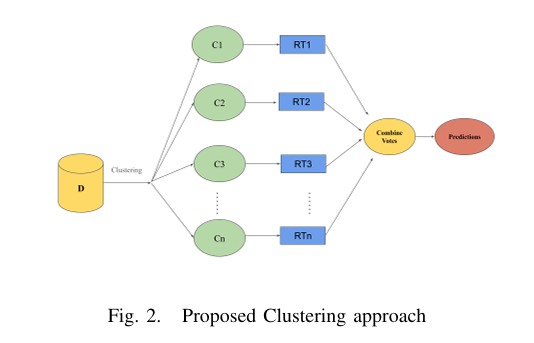
Random Forests and cluster-specified decision trees

Abstract

A hybrid Random Forest and K-means approach for heterogeneous, high-dimensional data. Explores ensemble learning combined with unsupervised clustering to improve classification boundaries on complex, overlapping feature spaces.

Machine LearningClusteringEnsemble Methods
Image coming soon

PDF-Malware-Inspector

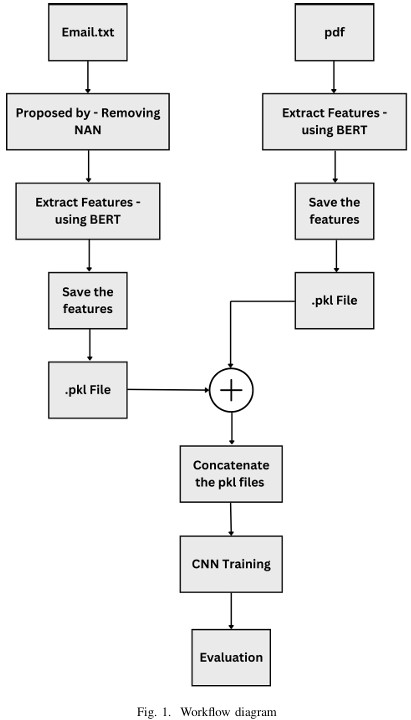
Deep learning detection for document-based email malware

Abstract

BERT embeddings and CNNs for feature extraction, reaching 97% accuracy across multiple datasets. Abstract to be added.

Deep LearningNLPCybersecurityBERT
A Smart Health & Hospital Monitoring System

A Smart Health & Hospital Monitoring System

IoT patient monitoring and autonomous robotics

Abstract

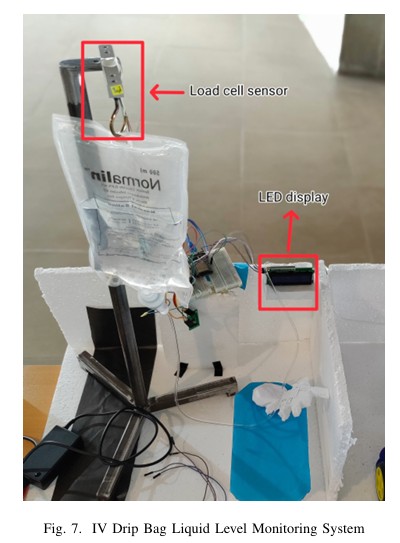
MediFriend integrates an autonomous robot with ESP32-based vital sign tracking. It automates IV saline level detection and transmits real-time data to a cloud dashboard, reducing staff workload and minimizing human error.

IoTESP32RoboticsSmart Healthcare